A Peak into India’s Digital Era
From Papers to Screens
Posted On
27/10/23 15:09

A Spectacle that Transformed the Landscape of our Economy.
There was a time not very long ago when the world of governance in India was ruled by paper - An economy where documents and files dictated the pace, nature, and ambiance of the entire population and its organization.
As India moved forward, an undeniable shift came forth - faster than ever, one that changed the narrative of our country backed by impactful ideas and speedy march of technology.
Digitalisation in Governance:
Today, papers have been replaced by screens and the little pixels that form QR codes and images on the screen have become not just the foundation, but architects of how Indian governance works. The technological transformation that has occurred in India is going to be remembered for generations to come. This shift has fundamentally altered the scene of Indian governance. The internet penetration rate in India has reached over 50% of the total population in 2023. (source: The Hindu)
Government workings have increasingly become tech-savvy, adopting digital tools and platforms that redefine the landscape of our economy. From communication to documentation, the digital landscape has become the new normal, enabling seamless workflows and rapid decision-making at all stages.
Daily and necessary tasks such as eFiling of ITR, Insurance Claims, and other important documents have made complicated procedures simpler and easily accessible. Making the most of Government Scheme Benefits for needy users and those in remote areas has also solved the problem of reach and transparency for the government.
The most significant change however occurred when this same transformation seeped in through our population - a population where the majority of families and individuals have had humbler standards of living. In a nation where there has been a time when basics like electricity or water take time to reach each individual, digital transformation has intricately built its place.
Digitalisation extended to Citizens:
The first and most crucial step that marked the commencement of this incredible journey was the introduction of the UIDAI (Unique Identification Authority of India), also known as the Aadhar Number. This was ground-breaking for the government as until 2010, a large part of the Indian population lacked any formal identification in the first place. Aadhar cards enabled the creation of several other innovative programs in India. By October 2021, 1.31 Billion Aadhar Cards have been issued in India and even more are being issued as of now. (source: statista)
This milestone was set even more prominently as we went on to establish the online payment system and have it seep into the system deep enough to reach remote areas. Today, India ranks first across the world in Digital Payments. In the financial year 2023, over 103 billion digital transactions worth over 166 trillion Indian rupees have occurred in India. This number is estimated to rise to at least over 411 billion by the financial year of 2027 in India. (source:GOI)
Volume and Value of Digital Payments in India:
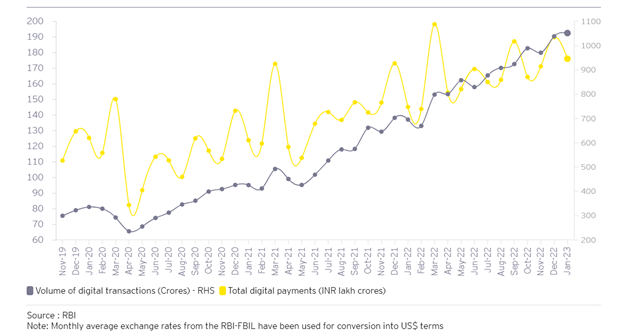
Doing this regulated the governance as it reduced the informal economy even further and established a deeper sense of financial inclusion. India shifted with a general increase in the population of the number of people who preferred online payments over cash even if it were simply for the sake of convenience. This not only has come to reduce corruption, but several other forms of inefficiencies too.
Digitalisation for MSMEs:
With UPI payments, came an influx of small business owners. Online Data Governance backed by Account Aggregators changed the game for the Indian economy in this regard. It is a system that acts as a mediator between Financial Information Users and Financial Information Providers. This has made accessing, using and monitoring data convenient, easy, and secure. What has that led to?
The biggest advantage has been the fact that it has helped MSMEs get easy loans and financial aid for their businesses, giving a platform to generate not just employment in remote areas, but also create substantial amounts of profit for those in need. About 75 Billion Zero Balance Bank Accounts have been set up since then. With a financial inclusion of those that are in need economically, this landscape largely benefitted the government as well. The expansion of credit to smaller businesses gives a better stand for the population and the national government as a whole.
Digitalisation for Health and Infrastructure:
Each of these breakthroughs is backed by a number of over 850 to 900 million internet users who have been benefiting from some of the most affordable data costs compared to the world. Right from regulating the pandemic through the CoWIN app, to the development of AI-powered language translator platforms, from the Gati-Shakti platform that used digitalization for mapping infrastructure and mapping deliveries, our country’s digital platform scenario has been overcoming global-level challenges with stable, ever-growing, and secure solutions. - And this is just the tip of an iceberg that on the whole signifies the humongous amount of growth, opportunities, and pinnacles that India is enabled to achieve with the advent of digitalization in India’s public governance and economy.
In a country with a population ratio as vast as India, digitalization has changed the game by connecting each individual with their government through a few clicks. While we yet have a lot to adapt, observe, and inculcate from first-world nations and draw inspiration from them to guide this streamline of digitalization towards even more breakthroughs, the pace at which we have been growing and accepting this is something we must collectively continue and strive to do.
Conclusion:
The digitalization of public governance in the Indian economy is not merely a trend but it is a transformative force. The achievements are evident, from streamlined administrative processes to economic growth. In this journey towards a digitally empowered future, AppVista is a committed partner in building strong and empowered digital ecosystems. As we navigate this evolutionary path, the unwavering dedication of our company mirrors the commitment to a digital tomorrow.
Let’s join hands and shape the narrative of progress together while making the most of the opportunities that technology offers. - for India and with India!
For an optimal experience, please
rotate your device to portrait mode.